|
Home
Upcoming Events-
Details
George
Washington
Lucretia Garfield
Mary
Todd Lincoln
Theodore
& Edith
Roosevelt
Eleanor Roosevelt
Abraham
Lincoln
James
Garfield-
NOW RETIRED
Ulysses
S. Grant
Suggested
Program
Topics
Testimonials
Previous Programs & Venues (page 1)
Presidential Homes and Historic Sites
Educational Links
Local Mentor, Ohio & other
links of interest
Archived Events
Contact
Information:
For general
information regarding reasonable fees and bookings contact us at:
| |
Do you want to know the definition of Living Historian?
click
here
|
James A. Garfield |
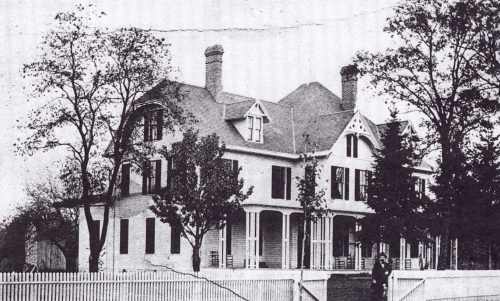 |
Here’s
a picture of James Garfield standing by his front gate in front of his
Mentor Farm (“Lawnfield”) in the fall of 1880. By the time this photo
was taken, he had won the presidential election of 1880. This is what
the house looked like the last time Garfield saw it, too.
The
National Parks Service now runs Garfield's home, Lawnfield. Here
is the link.
http://www.nps.gov/jaga/
People can take a virtual tour of the
Lawnfield property – interior and grounds -- at
http://www.wrhs.org/html/lawnfield/tour.htm
This
accesses a site originally created by the Western Reserve Historical
Society. At some point in the future this site link may no longer
be active.
|
|
|
|
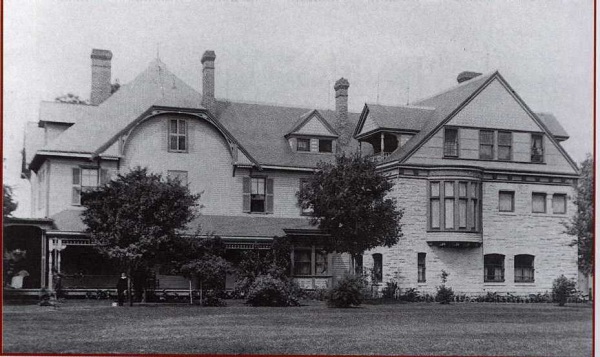 |
This picture shows the east side of
the Garfield home, circa 1900, after Lucretia added the Memorial
Library addition onto the back portion of the house. The library
was the first presidential memorial library in the country and set
the precedent for future presidential libraries being established.
Lucretia used it to house her husband’s many books and personal
papers. A fire-proof vault sits within the library and is the spot
where Garfield’s papers were stored until the 1930s. They are now
part of the Garfield Collection at the Library of Congress in
Washington, D.C. The original books are still housed in the library
at Lawnfield in Mentor. |
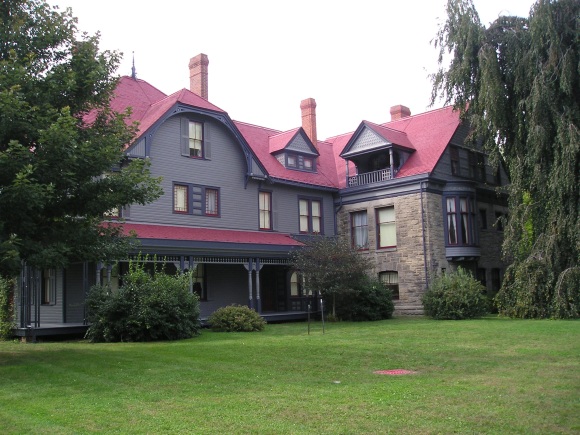 |
This
is a modern view (taken in 2005) of the east side of the Garfield
house. The tree to the far right is a Weeping Beech that was planted in
1900! |
| |
|
Ulysses S. Grant |
|
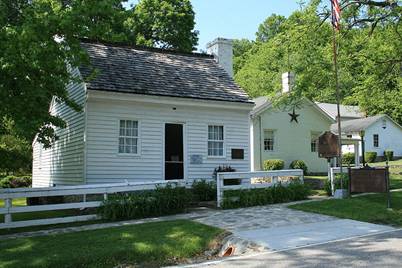 |
Ulysses S. Grant was born here in Point Pleasant near the mouth
of Big Indian Creek at the Ohio River on April 27, 1822. This
restored one-story, three-room cottage, which was built in 1817,
was next to the tannery where Grant's father, Jesse, worked.
You can tour the small cottage that is furnished with period
items and some family pieces, such as Jesse Grant’s trunk. At
one time, the birthplace made an extensive tour of the United
States on a railroad flatcar and was also temporarily displayed
on the Ohio State fairgrounds.
|
|
U.S. Grant Birthplace (born Hiram Ulysses
Grant -1822;
home built in 1817) -Point Pleasant, OH |
|
|
|
|
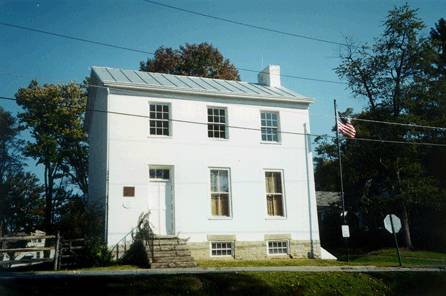
This
was Grant’s childhood home from 1823 until 1839, when he left to
attend West Point. Ulysses Grant lived in this home longer than
any other during his lifetime. His parents, Jesse and Hanna
Grant, built the original two-story brick section of the house
when they moved 20 miles east to Georgetown from Point Pleasant,
OH (where Hiram Ulysses - later changed to Ulysses Simpson) had
been born the year before. Additions were made over the years
to enlarge
and improve the house for Grant, his parents, and four
siblings. The house now holds Grant and Georgetown memorabilia
and has seasonal tours.
During his youth here in Georgetown, Grant attended school,
worked in his father's tannery, and spent hours in his favorite
pastime - working with horses. The little schoolhouse on Water
St. can be visited nearby. From age 6 to 13, Grant attended
school there and his teacher, John White, is mentioned in
Grant’s “Memoirs.”
|
|
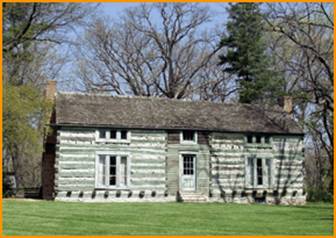
Ulysses cultivated the 80 acres near White Haven (St. Louis, MO)
given to the Grants as a wedding gift and managed the rest of
the land of his father-in-law, Colonel Frederick Dent.
With help from the Dent family slaves, Grant established a farm
and constructed his own house – a log cabin, the first home that
Julia and he ever owned. Julia recalled that it was “so
crude and homely I did not like it at all, but I did not say so.
I got out all my pretty covers, baskets, books, etc., and tried
to make it look home-like and comfortable, but this was hard to
do. The little house looked so unattractive that we
facetiously decided to call it Hardscrabble.”
They only
lived there for three months, but due to its association with
the famous General and President, it was dismantled and moved
three times, until it was finally located on the property of the
present day Grant’s Farm (http://www.grantsfarm.com/),
which is owned and operated by Anheuser-Busch, and adjacent to
Ulysses S. Grant NHS.
|
|
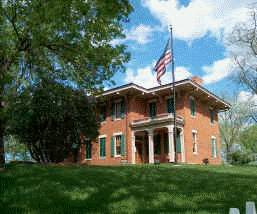
The brick house, which was designed by William Dennison, had
been constructed in 1860 for a former Galena, IL city clerk.
Thomas B. Hughlett, on behalf of a small group of local
Republicans, purchased the house for $2,500 in June 1865 and
presented it to U.S. Grant two months later. On August 18,
1865, the citizens of Galena greeted the return of its
victorious Civil War general with a grand celebration. A
"grand triumphal arch" spanned Main Street, and a holiday
atmosphere prevailed with a jubilant procession, speeches, and
evening fireworks. Julia Grant recalled that "there was a
tremendous and enthusiastic outpouring of people to welcome him
. . . After a glorious triumphal ride around the hills and
valleys, so brilliant with smiles and flowers, we were conducted
to a lovely villa exquisitely furnished with everything good
taste could desire." Quite the contrast to “Hardscrabble”!
Following his election as President in 1868, he visited this
home only occasionally. In 1873 Grant commented that "although it
is probable I will never live much time among you, but in the future be
only a visitor as I am at present, . . . I hope to retain my residence
here . . . I expect to cast my vote here always." The house was
maintained by caretakers in anticipation of the President's visits, the
local newspaper reporting that it was "in excellent order and ready for
occupation at any time," adding that "visitors are always admitted."
Grant made his final visits to his Galena home in 1880.
|
|
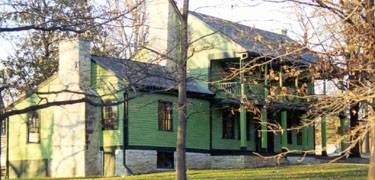
Second Lieutenant Ulysses S. Grant was assigned to St. Louis'
nearby Jefferson Barracks following his graduation from West
Point in 1843. Soon after arriving in the city, he visited
the family of his former roommate, Frederick Dent, at their
plantation on Gravois Creek. There he met Fred's sister
Julia, and afterward his visits became quite regular. Upon
learning of his regiment's impending transfer, Grant proposed to
Julia in 1843, and the couple eventually married in 1848.
The White Haven property was a focal point in Ulysses' and
Julia's lives for four decades. The Grants lived here off
and on during the 1850s. Although the family moved to
Galena, Illinois, in 1860, the Grants continued to think of
“White Haven” as their family home. By 1870, President
Grant owned nearly 650 acres of the “White Haven” farm and began
readying the property for a relaxing retirement. Although
circumstances caused him to abandon those retirement plans,
Grant retained ownership of the property until a few months
before his death in 1885.
Today, that home commemorates Julia and Ulysses’ lives and
loving partnership against the turbulent backdrop of the 19th
Century. |
|
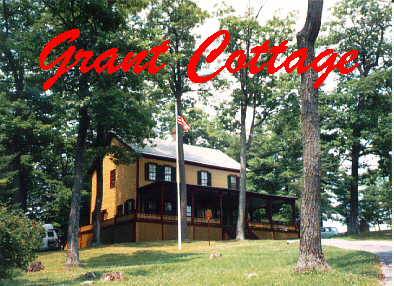
In this house in June and July of 1885, former General and
President Grant fought the pain and weakness of throat cancer as he
raced to complete his “Memoirs” and provide financial security for his
family. The furnishings, decoration, and personal effects remain
just as they were in 1885. The cottage is owned by New York State,
with tours and programming provided by the Friends of Grant Cottage.
|
| |
|
|